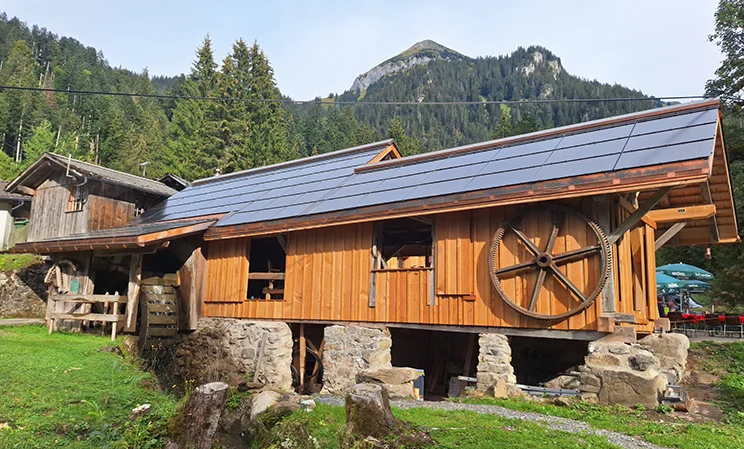
Alti Sagi Suld
When the rooms of the old sawmill, used as a storage area, were cleared out, the components of the frame saw installed in the 19th century came to light. The idea took shape to restore the old Suld sawmill and open it to the public. Experts from the Swiss Association of Mill Friends certified that the facility was in a condition worth restoring. The restoration was decided on and started in spring 2025. The Bernese Heritage Society (Berner Heimatschutz) and other institutions support the project.
Strengthening tourism in the region
The atmosphere of a working sawmill is to be recreated as authentically as possible. Guided tours make the operating functions and workflows tangible for visitors, and background knowledge is conveyed to suit each target group. The people of Aeschi and the surrounding area will benefit from a new cultural and tourist highlight that underlines the uniqueness of the Suldtal nature reserve. Thanks to the owners’ tourism-oriented approach, the continued operation of the facility is ensured.
The restored sawmill is meant to give both an older generation and groups interested in industrial history, as well as a younger audience such as school classes, an insight into a craft practised in the Suldtal for centuries. This is achieved through on-site information, but above all through the working sawmill itself, the power of the frame and the saw blade, and the scent of freshly sawn wood and sawdust.
Temporary exhibitions can introduce interested visitors to the trades connected with the sawmill, such as lumberjacks, sawyers, carpenters, timber framers and foresters. Exhibitions of historical tools and equipment used in forestry can also be offered. All of this takes place in a cantonally designated nature reserve – authentic to experience and educational.
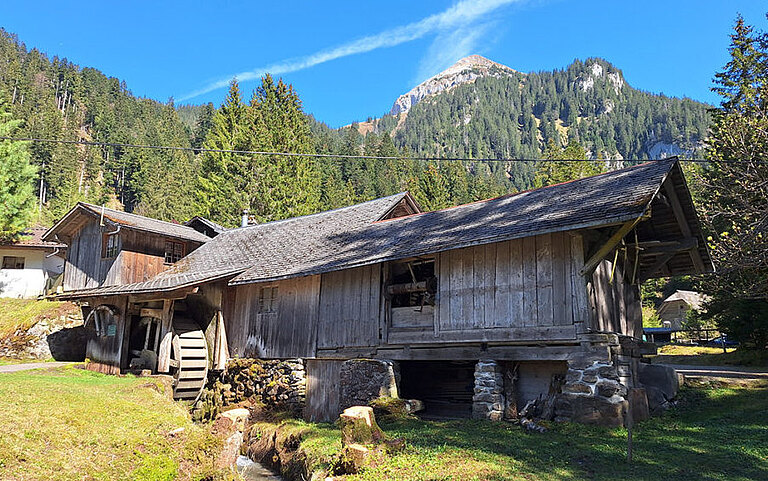
History
Origins
The history of the water wheel at the far end of the Suldtal in the Bernese Oberland goes back a long way. A sawmill is documented there as early as the 16th century. Water power was used to run a sawmill until 1963, and the facility has stood idle since then. The owners proved innovative at the beginning of the last century: the water wheel has been generating electricity since 1925 – even before the village of Aeschi was supplied with power – and still contributes to the energy needs of the Gasthaus Suld as a whole.
The people behind it
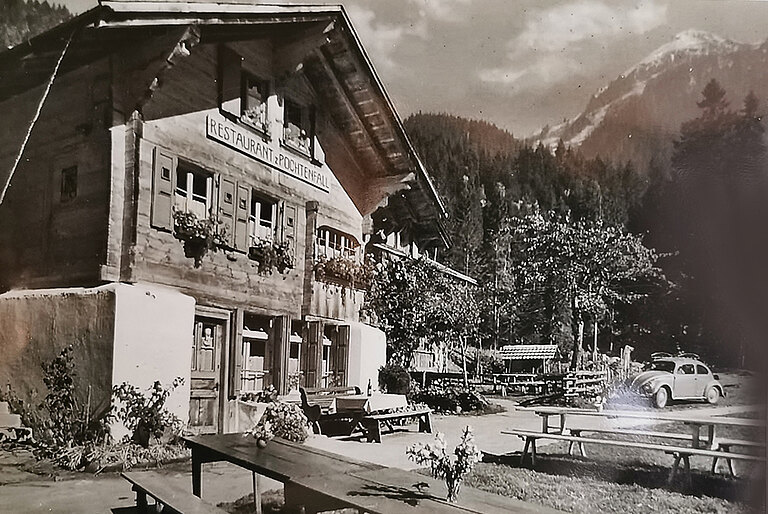
In 1914, Friedrich Lauener added a seasonal restaurant to the sawmill. The thriving inn was extended in 1931 with a hall seating 80 people. From 1960, the Käthi and Fritz Hari family took over the inn, which was later continued by their daughter Barbara and Albert Fuhrer. In 2024, ownership passed to the locals Heidi and Adrian Bircher and Rolf and Silvia Zurbrügg. They are responsible for ensuring that the water wheel keeps turning.
Experience the Alti Sagi Suld up close
On a guided tour of about two hours, you will learn how the sawmill came into being and what history has shaped it over the years.
You will hear about the challenges the restoration brought and how much dedication went into bringing this historic building back to life. On the tour, you follow the path of the water: from the water intake that powers everything, to the sawmill that springs into motion thanks to the water power, until finally sawing begins again. And when the Sagi starts up, you can sometimes lend a hand yourself.
Right next to the sawmill, the Gasthaus Suld and the log cabin invite you to linger. In the small Sagi shop you will also find regional and wooden products – a lovely souvenir of your visit.